
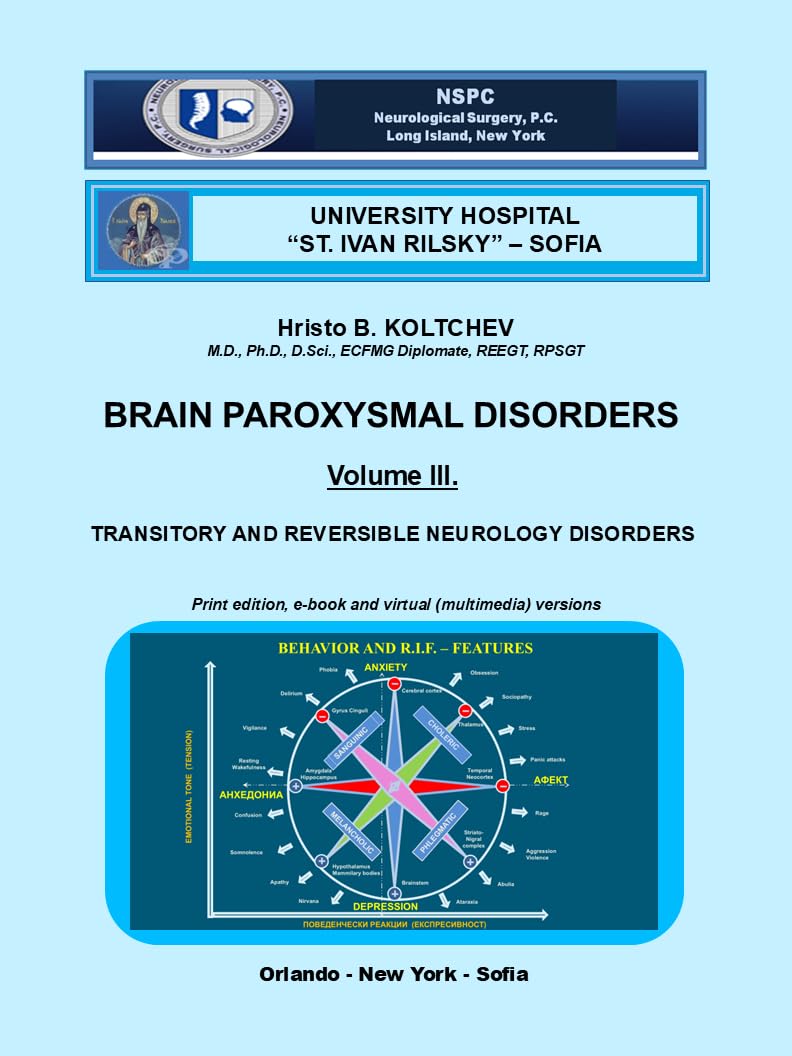
BRAIN PAROXYSMAL DISORDERS Vol. III.: Transitory and Reversible Neurology Diosrders Kindle Interactive Edition
Product details
| Management number | 220507221 | Release Date | 2026/05/03 | List Price | $90.00 | Model Number | 220507221 | ||
|---|---|---|---|---|---|---|---|---|---|
| Category | |||||||||
This book is the 3rd volume of a 3-volume comprehensive guide to Brain Paroxysmal Disorders (BPD). Brain paroxysms generate behavioral acts. The environment or the own organism (homeostasis) triggers brain paroxysms of a physiological (adaptive) or abnormal (pathological) nature.This comprehensive Textbook (1310 pages, 378 figures, 182 tables, and more than 40 virtual illustrations (in the multimedia version of the book)) consists of 16 chapters, summarized in 3 main parts: I. FUNDAMENTAL ASPECTS (Doctrines on the structure of the nervous system and hypotheses for its functioning, as well as the methods for polygraph registration and data archiving); II. THE EPILEPTIC CONGLOMERATE (Neurobiology, Clinical phenomenology, Therapeutic management of epilepsies); and III. TRANSITORY AND REVERSIBLE NEUROLOGICAL DISORDERS (Clinical aspects of BPD).The faces of BPDs are countless and diverse; starting with seemingly harmless obsessions and phobic states, going through the numerous forms of pain, emotional, behavioral, and cognitive-social events, and ending with the dramatic forms of epileptic seizures (convulsive and non-convulsive syndromes), BPD can rightly be considered the "Great Imitator" of all neurological disorders.This type of disorder is the reason for about 65-75% of visits to neurological outpatient departments.We have made consistent and persistent efforts to present the clinical facts on the principles of Evidence-based medicine (EBM). In the practically inexhaustible wealth of clinical facts, the need for conceptual organization is palpable. Clinical empirical facts that have accumulated over the centuries are the true wealth of clinical medicine. They are based on verifiable data gathered through the senses, which can be used to confirm or disprove a hypothesis and form the basis of scientific understanding. This was a challenge.Theoretical constructions (theories and hypotheses) are variable and unreliable tools in clinical medicine. However, the empirical approach functions in such a way that it further creates new knowledge about the way the world actually works. Scientific experiments and observations give rise to new empirical data. Therefore, empirical data need to be organized (classified), and scientific theories need to be conceptualized.I wish the readers to feel the same pleasure in reading that I felt in writing. Read more
| XRay | Not Enabled |
|---|---|
| Format | Print Replica |
| Language | English |
| File size | 231.6 MB |
| Page Flip | Not Enabled |
| Word Wise | Not Enabled |
| Print length | 484 pages |
| Accessibility | Learn more |
| Publication date | November 15, 2025 |
| Enhanced typesetting | Not Enabled |
Bestseller ranking
Androids, Robots & Artificial Intelligences




Customers who viewed this product also viewed
Medical eBooks




Correction of product information
If you notice any omissions or errors in the product information on this page, please use the correction request form below.
Correction Request Form